
Construction companies are under more pressure than ever to modernize. Contractors are adopting construction management software, CRM systems, estimating tools, automation platforms, AI workflows, and field productivity apps to improve visibility, reduce rework, and scale operations.
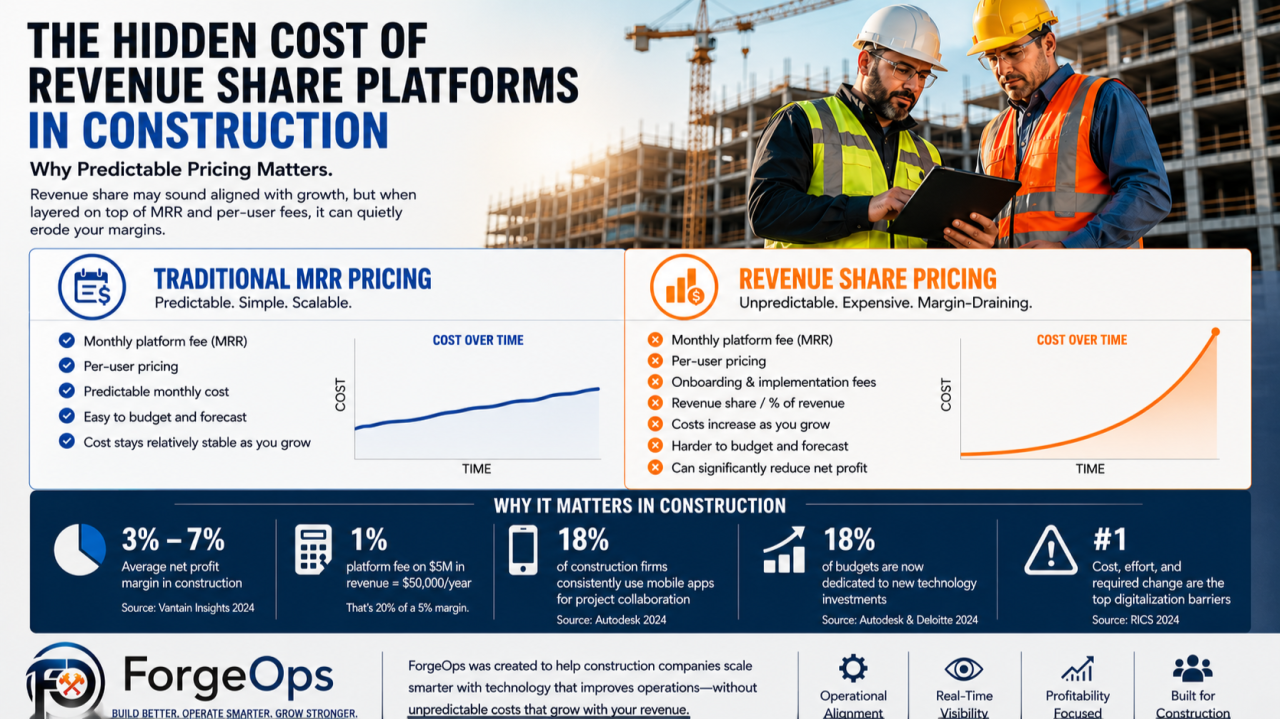
But as more construction technology platforms enter the market, pricing models are becoming harder to compare.
Many platforms no longer charge only a simple monthly subscription. Instead, they combine:
- Monthly recurring revenue, or MRR
- Per-user licensing
- Implementation or onboarding fees
- Support fees
- Transaction fees
- Revenue share or percentage-based pricing
For construction businesses already managing tight margins, this matters.
A revenue share platform may sound appealing because it appears tied to growth. But when revenue share is layered on top of standard software costs, it can become significantly more expensive than traditional SaaS pricing — especially for growing contractors, subcontractors, specialty trades, and construction service companies.
That is one of the reasons ForgeOps was created.
Construction Already Operates on Thin Margins
Construction is not an industry where companies can ignore small percentage costs.
Industry benchmark data commonly places average construction net profit margins in the low single digits, often around 3% to 7%, depending on trade, region, company size, and project mix.
That means a platform taking even 1%, 2%, or 3% of revenue can have a major impact.
For example:
A contractor doing $5 million in annual revenue with a 5% net margin earns roughly $250,000 in net profit.
If a software platform charges:
- $2,500/month base MRR = $30,000/year
- $100/user/month for 10 users = $12,000/year
- 1% revenue share = $50,000/year
That company is paying $92,000/year in platform costs.
That is not just a software expense. That is more than one-third of the company’s net profit.
The Problem With Revenue Share on Top of MRR
Traditional SaaS pricing is usually easier to forecast. A company pays a monthly or annual subscription, often based on users, features, or modules. Per-user subscription pricing is still one of the most common models for cloud-based construction software, with industry pricing often ranging from roughly $30 to $350+ per user per month, depending on the platform and functionality.
Revenue share changes the equation.
Instead of paying only for access to the system, the contractor pays a percentage of business activity flowing through the platform.
That can include:
- Closed revenue
- Booked jobs
- Lead value
- Project volume
- Transaction volume
- Gross contract value
The problem is not always revenue share by itself.
The problem is stacked pricing.
When a construction software platform charges MRR, per-user fees, onboarding, and revenue share, the customer may be paying multiple times for the same operational workflow.
Revenue Share Can Penalize Growth
Revenue share pricing is often marketed as “we win when you win.”
But construction growth is rarely created by one software platform.
Growth comes from:
- Strong estimating
- Sales follow-up
- Project execution
- Field productivity
- Reputation
- Referral relationships
- Labor planning
- Vendor coordination
- Market demand
- Leadership and operations
If a contractor grows from $5 million to $10 million in revenue, a percentage-based platform automatically captures more money, even if the software did not directly create all of that growth.
That turns technology into a variable cost that rises with success.
For construction companies, that can create margin compression.
Digital Tools Are Important — But Adoption and ROI Matter
This is not an argument against construction technology.
The research is clear: construction needs better systems, better data, and better digital adoption.
Autodesk and Deloitte’s 2024 State of Digital Adoption in Construction report found that construction and engineering businesses are increasingly investing in technology, with average business investment in new technology rising to 18% of budgets in 2024, up from 15% in 2023. The same report found that construction management cloud software was used by 43% of surveyed businesses and mobile apps by 41%.
But buying technology is not the same as achieving ROI.
Autodesk’s Construction Disconnected research found that while 75% of surveyed firms gave project managers and field superintendents mobile devices, only 18% consistently used mobile apps to access project data and collaborate beyond basic email, text, or phone use.
That is the core issue.
Construction companies do not just need more software. They need systems that are implemented correctly, adopted by the team, tied to workflows, and measured against operational outcomes.
The Real Question: What Is the Total Cost of Ownership?
When evaluating construction technology, leaders should not ask only, “What is the monthly cost?”
They should ask:
- What is the base MRR?
- What is the per-user cost?
- Are there onboarding fees?
- Are there implementation fees?
- Are integrations included?
- Is support included?
- Is there a revenue share percentage?
- Is the percentage based on gross revenue or net revenue?
- Does the fee apply to all revenue or only revenue directly generated through the platform?
- What happens as we scale?
- What is the three-year total cost of ownership?
RICS’ 2024 Digitalisation in Construction report identified cost, effort, and required change as leading blockers to digitalisation in construction.
That means pricing clarity is not a small issue. It is a strategic issue.
Why ForgeOps Was Created
ForgeOps was created because construction companies need technology that improves operations without creating unpredictable cost structures.
We saw too many contractors dealing with:
- Expensive software stacks
- Underused platforms
- Disconnected systems
- Complicated implementation
- Per-user pricing that punished team growth
- Revenue share models that became more expensive as the company scaled
ForgeOps was built around a different belief:
Technology should help construction companies protect margin, not quietly dilute it.
Our goal is to help construction businesses build better operating systems across sales, workflow, automation, reporting, and execution — without forcing them into pricing models that become harder to justify as they grow.
Predictable Pricing Creates Better Business Decisions
Construction leaders need cost clarity.
They need to know what technology will cost this month, next quarter, and next year.
Predictable pricing helps companies:
- Forecast overhead
- Protect net margin
- Budget for growth
- Add team members without hesitation
- Measure ROI accurately
- Avoid surprise software costs
- Scale operations with confidence
Revenue share can work in some industries and some use cases. But in construction, where margins are tight and project economics are complex, percentage-based software pricing deserves careful scrutiny.
The Future of Construction Tech Should Be Transparent
The construction industry does not need more confusing pricing.
It needs technology partners that are transparent, operationally grounded, and aligned with contractor profitability.
Before signing with any platform, construction companies should understand the true total cost — not just the subscription cost, but the full impact of MRR, per-user fees, onboarding, implementation, transaction costs, and revenue share.
Because growth should not become a penalty.
And software should not become another tax on revenue.
That is why ForgeOps exists: to help construction companies modernize operations, improve visibility, and scale smarter — with technology built around clarity, adoption, and profitability.